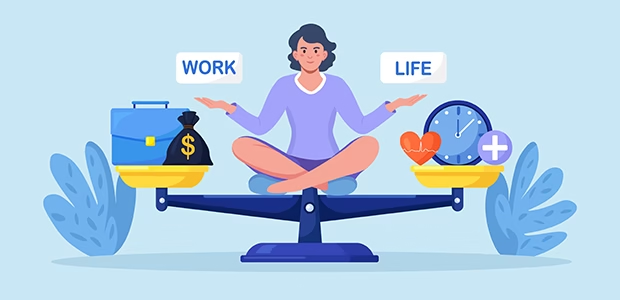
Working from home is often presented as the ultimate solution for work-life balance. No commuting, more flexibility, and the promise of having more time for yourself sound like the perfect recipe for a healthier life. Yet many people who start working remotely discover something unexpected: instead of gaining balance, they slowly lose it. Work invades personal time, days stretch longer than they should, and rest becomes incomplete. The truth is that working from home does not automatically improve your work-life balance. In fact, if you are not careful, it can destroy it. Balance must be created deliberately, otherwise work expands until it takes everything.
One of the main illusions of working from home is the belief that flexibility equals freedom. Flexibility simply means that your time is no longer controlled by external rules. Freedom, however, requires personal discipline. When you work in an office, the day naturally starts and ends through physical movement. You leave your house, arrive at work, and leave again in the evening. This simple movement creates mental transitions. At home, these transitions disappear. You wake up and you are already “at work.” You eat and you are still “at work.” You relax in the evening and part of your mind remains connected to unfinished tasks. Without clear borders, work becomes a permanent background noise that never truly shuts off.
This lack of boundary slowly damages your energy. Instead of having moments where you fully stop, you only shift between different degrees of work-related thinking. Even when you are resting, your brain stays partially engaged with responsibilities. Over time, this creates emotional exhaustion that feels strange and confusing. You may not be physically tired, yet you feel mentally drained. You might struggle to fall asleep because your mind keeps replaying emails, deadlines, or unfinished tasks. This is not a sign of weakness. It is simply a nervous system that never fully disconnects.

Another challenge is that when work is always available, stopping feels like a decision instead of a natural outcome. In an office, you leave because the day ends. At home, you stop because you choose to. That choice becomes harder when tasks are incomplete and responsibility feels close at all times. Many people feel guilty when they stop working, even if they have already done enough for the day. Over time, this guilt becomes exhausting. You begin to associate rest with laziness instead of recovery. Eventually, you reduce your breaks without realizing it, and your performance slowly collapses.
Balance also disappears when you fail to protect your personal identity. When work becomes the center of your life, everything else becomes secondary. Hobbies fade. Social life becomes harder to maintain. Even simple pleasures start to feel unnecessary. You tell yourself you will “get back to life later,” but later often never comes. Working from home makes this easier because there is no physical division between who you are as a professional and who you are as a person. Without clear separation, the two merge until work dominates everything.
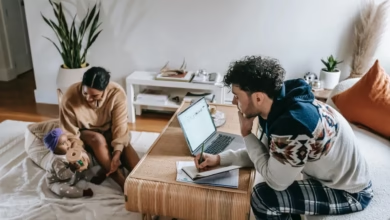
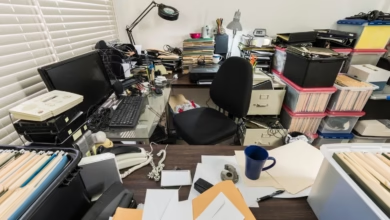
The environment plays a major role in how balanced your life feels. When your workspace is the same area where you eat, relax, or sleep, your brain is constantly confused. It does not know when to be active and when to calm down. Over time, this confusion creates tension that is difficult to consciously identify. You feel restless for no obvious reason. You may want to relax, but cannot. This is not laziness; it is environmental stress. Your surroundings constantly remind you of work, even when you try to stop thinking about it.

Social life also changes dramatically when you work from home. In an office, social interaction is built into your routine. Conversations happen naturally. At home, connections require effort. You must choose to reach out. Many remote workers do not realize how much isolation affects them until they feel emotionally flat. When you spend most days alone, motivation weakens, and mood slowly declines. This affects your personal life more than you expect. You may become less patient, less expressive, and less engaged with others. Balance does not exist without human connection. Work-life balance is also emotional balance, and humans are not designed to live without interaction.
Time perception changes in remote work as well. Without structure, extended workdays become normal. You start earlier, stop later, and often work through moments that should belong to rest. Over weeks and months, this distorts your sense of what a healthy rhythm looks like. In the beginning, you may even feel proud of working long hours. Later, you realize that productivity does not increase with exhaustion; it disappears under it.
Remote work also creates a false sense of efficiency. Because you are always “available,” you feel busy and important. But being busy is not the same as being effective. Without rest, creativity drops. Without free time, emotional health weakens. Balance is not a reward you earn after hard work. It is a condition that allows hard work to remain sustainable.
The most painful part is that imbalance builds quietly. There is rarely a crisis moment that tells you something is wrong. Instead, satisfaction fades first. You stop enjoying things you once loved. You become easily irritated. You feel tired for no clear reason. These are early warning signs, not personality flaws. They indicate that work has consumed too much of your mental space.
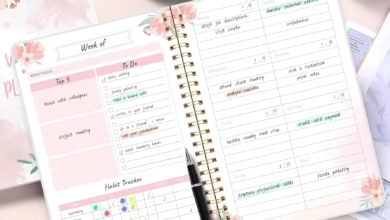
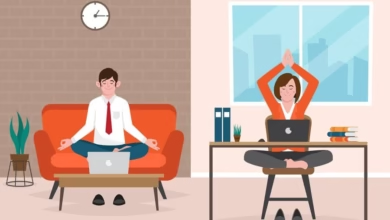
Rebuilding balance is not about working less. It is about working consciously. You must decide when your workday begins and when it ends, and treat those boundaries seriously. You must give your mind the signal that it is allowed to rest. When you close your laptop at the end of the day, it should feel final, not temporary. Over time, your nervous system will relearn relaxation, and your stress levels will decrease naturally.

True work-life balance is not about splitting hours perfectly between work and life. It is about creating a life where work supports your happiness instead of consuming it. When your work becomes one part of your life instead of your entire identity, balance becomes easier. Your energy improves. Your creativity returns. Your motivation stabilizes. You stop feeling trapped inside your own home.
Remote work has the potential to offer unprecedented freedom. But freedom without boundaries turns into pressure. The question is not whether working from home can give you balance, but whether you are willing to protect it.
Work-life balance does not appear automatically when you remove an office from your life. It appears when you take responsibility for your mental health, your time, and your energy. When you build these protections, remote work becomes a lifestyle that supports you. When you ignore them, it slowly erodes you.
The decision to protect your balance is not dramatic. It is quiet and continuous. Each evening you choose to stop working. Each morning you choose how you start your day. Each weekend you decide whether work enters your personal time or stays where it belongs. These small decisions accumulate into either burnout or health.
In the end, working from home is not a shortcut to a better life. It is an opportunity to design one. And like every design project, it only succeeds when you respect limits.